

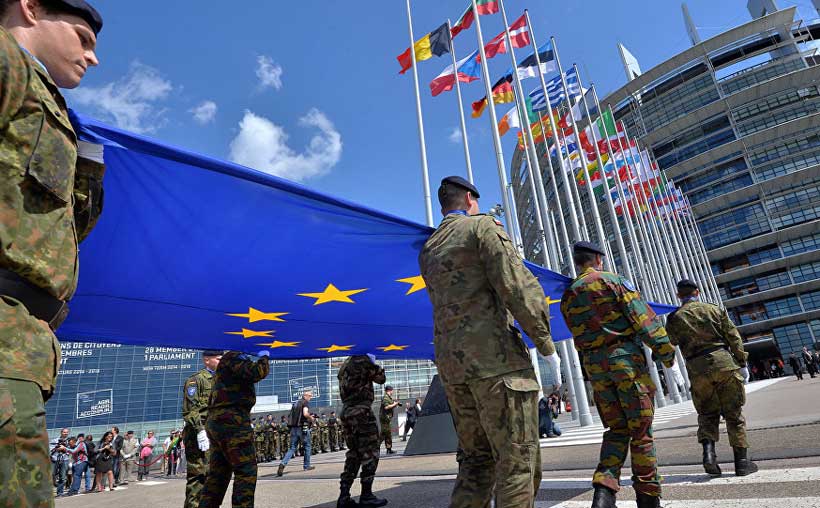
The idea of a common European army has long been debated by European political leaders, but it also has strong opponents. Polish Foreign Minister Radosław Sikorski has now put forward what he sees as a more feasible alternative: rather than merging the national armed forces of the European Union’s 27 member states, he has proposed creating a separate, permanent European military force, which he calls a kind of “European Legion.”

In an interview with Greece’s Kathimerini, published on Aug. 15, Sikorski said: “Europe needs much deeper military integration because Washington’s strategic focus is increasingly shifting towards the Indo-Pacific region. The ‘European Legion’ I am proposing would not replace NATO, but it would be rapid, effective and immediately deployable.”
Under Sikorski’s proposal, the United States would remain indispensable to Europe’s defence, but the continent would have to take greater responsibility for its own security.
A genuine “European Legion” could have its own personnel, permanent command structure, common training, logistics and operational culture. Its troops would not meet for the first time after a crisis had erupted, but would serve and train together in peacetime.
At the same time, such common European military cooperation would face not only legal obstacles but also ideological barriers rooted in national politics and culture, where the armed forces are widely seen as an expression of national strength.