

A journalist’s read on the latest EU assessment, and the harder story behind the headlines

When the European Commission’s 5th GSP+ monitoring report landed on desks in Islamabad this summer, the message from Brussels was blunt: Pakistan has “been facing compliance issues with its GSP+ obligations” and has “regressed in a number of areas while positive change was limited.” Coming just months before a new, tougher preferential trade framework kicks in on 1 January 2027, the language was designed to sting — and it did.
But if the report is read only as a rebuke, it misses the more complicated story unfolding in South Asia: a country juggling a full-blown insurgency on its western border, a nuclear-armed rival on its east, one of the world’s most punishing climate risk profiles, and a fragile post-default economy — while still, quietly, moving the needle on reform.
What Brussels Actually Said
The Joint Staff Working Document, published alongside the Commission’s report to the European Parliament, is the final assessment under the existing GSP regime and covers 2023-2025. It is not a walk-out notice. It is a warning shot with a to-do list attached.
On the debit side, the EU flags the familiar issues: weak enforcement of labour protections, a still-uneven fight against forced and child labour, worrying provisions in the amended Pakistan Electronic Crimes Act (PECA) and counter-terrorism laws, gaps in freedom-of-expression safeguards, and concerns about judicial independence following the latest constitutional amendments. Environmental compliance and governance — the two pillars that will carry heavier weight under the 2027 regulation — are singled out for closer monitoring.
On labour specifically, the report notes that fewer than 600 inspectors are expected to police a workforce of some 70 million, and that an estimated three million people remain trapped in debt bondage, largely in the brick kilns of Punjab and the tenant farms of Sindh. Trade unions remain weak, and social dialogue thin.
Yet the same document — and this is often lost in the coverage — takes visible care to list what Pakistan has done right. Islamabad ratified the ILO’s 2014 Protocol to the Forced Labour Convention in March 2025. It set up district vigilance committees nationwide. It secured its first-ever marital rape conviction, in Sindh, in February 2024. The National Commission for Human Rights earned “A status” from the Global Alliance of National Human Rights Institutions. Implementing rules under the Anti-Torture Act were adopted, the de facto moratorium on executions held, and a National Commission for Minorities was legislated. Even the Commission’s own language conceded that these are “notable developments” — the issue, it argued, is that “most progress is of legislative and administrative nature and needs to be translated into real improvements on the ground”.
That is a fair criticism. It is also a criticism you can only make of a government that has, in fact, been legislating in the right direction.
The Story Brussels Underplays
Any honest assessment of Pakistan’s compliance record has to reckon with the ground the country is standing on — and the report acknowledges this only in passing.
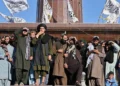
A live counter-terrorism war. Since the Taliban’s return to Kabul in 2021, attacks by the Tehrik-i-Taliban Pakistan (TTP) and affiliated militants have escalated sharply. UN experts warned in March 2026 of hundreds of deaths and tens of thousands displaced along the Afghan-Pakistan border, calling for “lasting peace.” Pakistan’s own tally, presented at the UN Security Council in June, put losses at more than 5,300 terrorist incidents and over 1,200 lives — with the government pointing directly to sanctuaries on Afghan soil. A short but sharp Afghanistan-Pakistan military exchange in February 2026 underscored just how volatile the frontier has become.
It is against this backdrop — not in a vacuum — that Islamabad has tightened its counter-terrorism statutes. Brussels is right to worry about vague provisions being misused; but a government losing soldiers and civilians every week to cross-border militancy is not going to look like a peacetime democracy in Northern Europe. That context deserves more weight than the report gives it.
An unresolved conflict with India. The four-day India-Pakistan war of May 2025, and the diplomatic freeze that has followed, has consumed enormous political and fiscal bandwidth. Indian outreach to the Taliban authorities in Kabul — even as those authorities host groups attacking Pakistani troops — is not a marginal irritant. Analysts writing in The Diplomat and Foreign Affairs this year have described a South Asia in which the risk of another, more serious conflict remains uncomfortably high, and in which Islamabad is spending scarce diplomatic capital simply to keep the temperature down.
A climate emergency. Pakistan topped the Global Climate Risk Index in 2024. The 2022 super-floods and the 2025 floods together displaced millions and blew holes in provincial budgets that were supposed to be paying for the very inspectorates and labour courts the EU wants strengthened. It is difficult to expand a labour inspection regime when the districts you are inspecting are under water.
A post-default economy. Pakistan came within a whisker of sovereign default in mid-2023. The World Bank estimated 47.2% of the population was living in poverty in 2025. The IMF programme still frames every fiscal choice. In this environment, the fact that the government has kept ratifying conventions and passing implementing legislation at all is not a small thing.
The Positive Trajectory
Read against those constraints, the direction of travel is more encouraging than the headline verdict suggests.
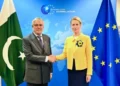
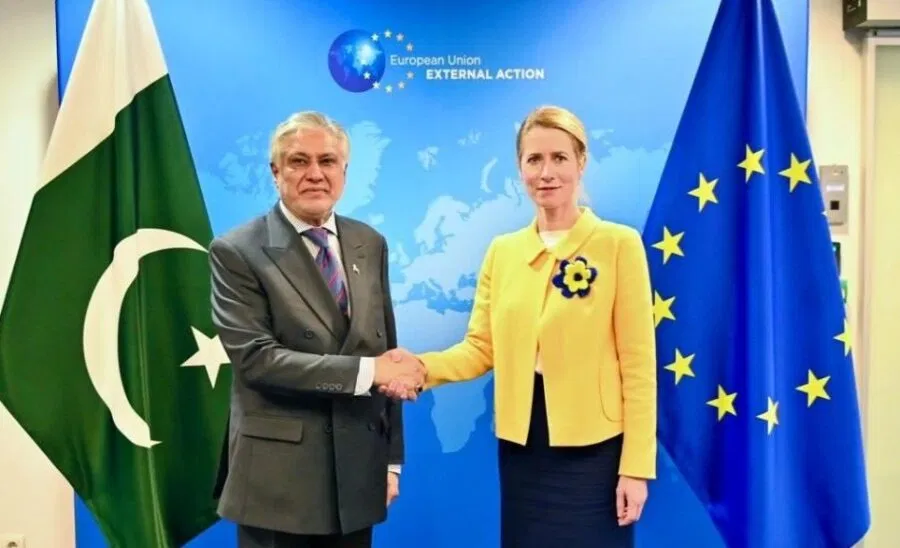
Bilateral engagement is deepening, not fraying. The 8th Round of the Pakistan-EU Strategic Dialogue, co-chaired in Islamabad on 1 June 2026 by Deputy Prime Minister Ishaq Dar and EU High Representative Kaja Kallas, produced a joint communiqué that spoke of “positive momentum” and “increasing high-level exchanges.” The first-ever Pakistan-EU Business Forum was held in April 2026, launching an EU-Pakistan Business Network, and both sides agreed to make it a recurring fixture.
Islamabad has already declared its “keen interest” in joining the new GSP+ scheme from 2027, and the EU has committed to work with Pakistan on meeting the tougher conditions. The Talent Partnership Roadmap on labour mobility is being implemented. Cooperation on counter-terrorism, migration, and multilateralism was reaffirmed. Kallas, notably, “commended Pakistan’s constructive and meaningful role” in mediating US-Iran tensions and hosting the Islamabad Talks — a diplomatic profile that would have been unthinkable a few years ago.
The trade numbers tell a similar story. EU imports from Pakistan recovered from €7.9 billion in 2023 to €8.3 billion in 2024, with GSP+ utilisation climbing back to 95%. Roughly €732 million in tariff exemptions flowed to Pakistani exporters last year — money that funds precisely the kind of formal-sector, unionisable, inspectable jobs that Brussels says it wants to see more of.
Why the Onus Now Sits in Brussels
Here is the uncomfortable part for the European side: the leverage the EU holds — GSP+ access — is also the EU’s chief instrument for the outcomes it wants. Pulling that lever too hard, or too publicly, risks collapsing the very export sectors (textiles, garments, leather, surgical instruments) that formalise labour, employ women outside the home, and give Islamabad the fiscal room to fund the reforms Brussels is asking for.
That is not an argument for indulgence. The EU is right to demand accountability, stronger labour inspection, credible action on child labour and bonded labour, a revisit of the vague provisions in PECA and counter-terrorism statutes, and firmer environmental delivery. These are also, self-evidently, in Pakistan’s own interest.
But the EU should recognise three things. First, Pakistan is not backsliding from a stable baseline — it is trying to legislate reform through a genuine security emergency, a hostile neighbourhood, and back-to-back climate shocks. Second, the incentives model works: almost every positive step the Commission itself catalogues — from the marital-rape conviction to the ILO protocol ratification to the NCHR’s upgrade — happened because GSP+ conditionality gave domestic reformers a lever to pull. Third, the alternative to European engagement is not a more compliant Pakistan; it is a Pakistan pulled more decisively into other spheres of influence, at precisely the moment Brussels is trying to build strategic depth in Asia.
The Commission’s report is best read, therefore, not as a threat but as a contract renewal notice. Pakistan needs to do more, and faster, on labour enforcement, environmental delivery, media-law reform and judicial safeguards — and the government appears, at least at the level of stated intent, willing. The EU, for its part, needs to keep the door to the 2027 scheme visibly, credibly open, invest in the technical assistance that makes compliance possible, and resist the temptation — audible in some European capitals — to treat conditionality as punishment rather than partnership.
Pakistan’s trajectory, for all its bumps, is pointing in the right direction. Whether that trajectory holds will depend less on another sternly worded staff working document, and more on whether Brussels chooses to be the partner it says it wants to be.