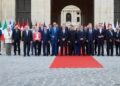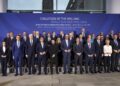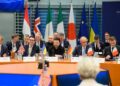


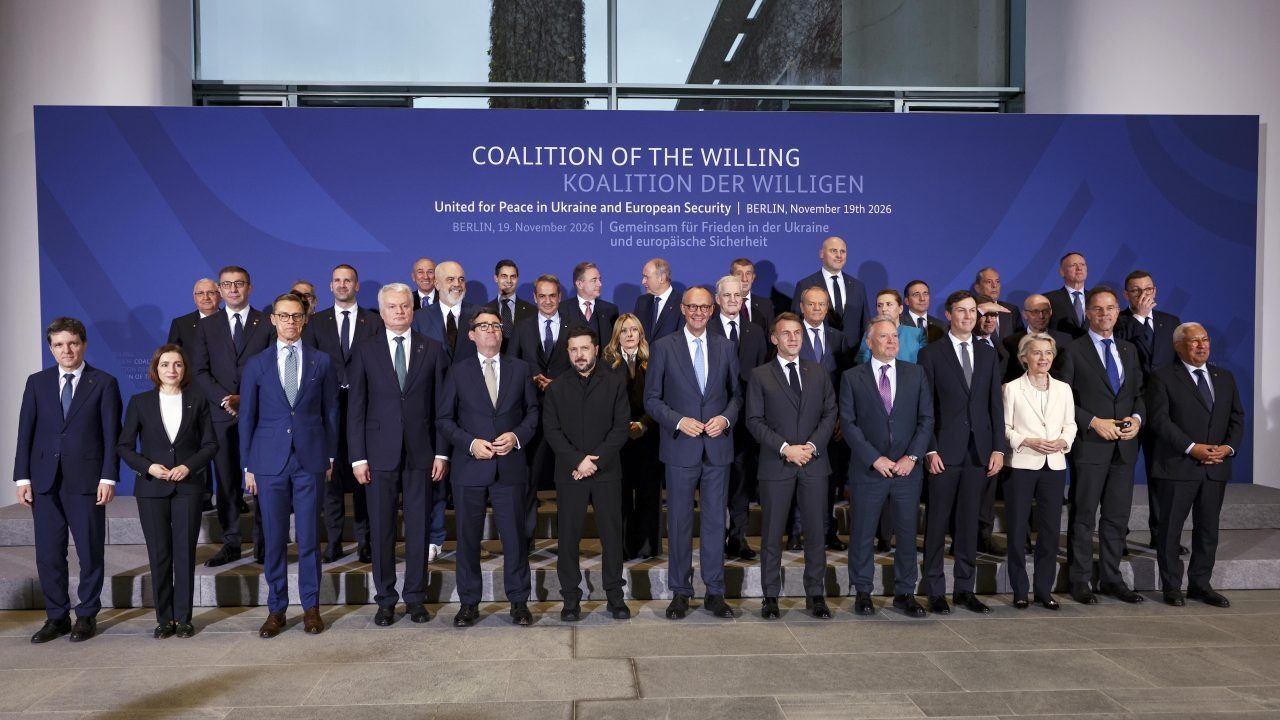
Leaders and representatives from roughly 37 countries gathered in Berlin Thursday for a high-level meeting of the Coalition of the Willing, an informal grouping of mostly European states supporting Ukraine.
Co-hosted by German Chancellor Friedrich Merz, French President Emmanuel Macron and British Prime Minister Andy Burnham, the summit took place on the same day as the first-ever trilateral meeting between U.S. President Donald Trump, Russian President Vladimir Putin and Chinese President Xi Jinping in Shenzhen, China, on the sidelines of the APEC summit.
German Foreign Minister Johann Wadephul described the Berlin gathering as the largest meeting of Ukraine’s supporters to date and a strong signal to Moscow that it is time to take negotiations to end the war seriously. He stressed that allies remain firmly behind Kyiv and are prepared to ensure Ukraine can negotiate from a position of strength, while warning that peace talks could still fail.
Discussions focused on implementing the European Commission’s proposal for €45 billion in support for Ukraine for 2027, strengthening air defences (including through the PURL mechanism for U.S.-made systems such as Patriot interceptors), a winter package of anti-ballistic interceptors, new joint European defence capabilities, and preparations for robust, legally binding security guarantees that could include a multinational force after any ceasefire.
U.S. special envoys Steve Witkoff and Jared Kushner attended, as did Ukrainian President Volodymyr Zelenskyy, NATO Secretary General Mark Rutte and EU leaders including European Commission President Ursula von der Leyen. According to some reports, Trump briefly joined the meeting online, from Air Force One upon his return from Shenzhen.
Participation was substantial but not universal among EU members. Official German listings of the broader Coalition include countries such as Bulgaria and Hungary, yet several Central and Eastern European states have been skeptical.
Slovakia is not a member: Prime Minister Robert Fico has repeatedly stated that Slovakia “wasn’t, isn’t and won’t be” part of the Coalition of the Willing and will not participate in further loans for Ukraine. Bulgaria has similarly said it has never officially joined the informal grouping; Rumen Radev’s government has ruled out supplying weapons from national stockpiles and limited further lethal aid. EUalive has also noted opposition from Slovakia, Hungary, Czechia and Bulgaria to additional EU financing mechanisms.