

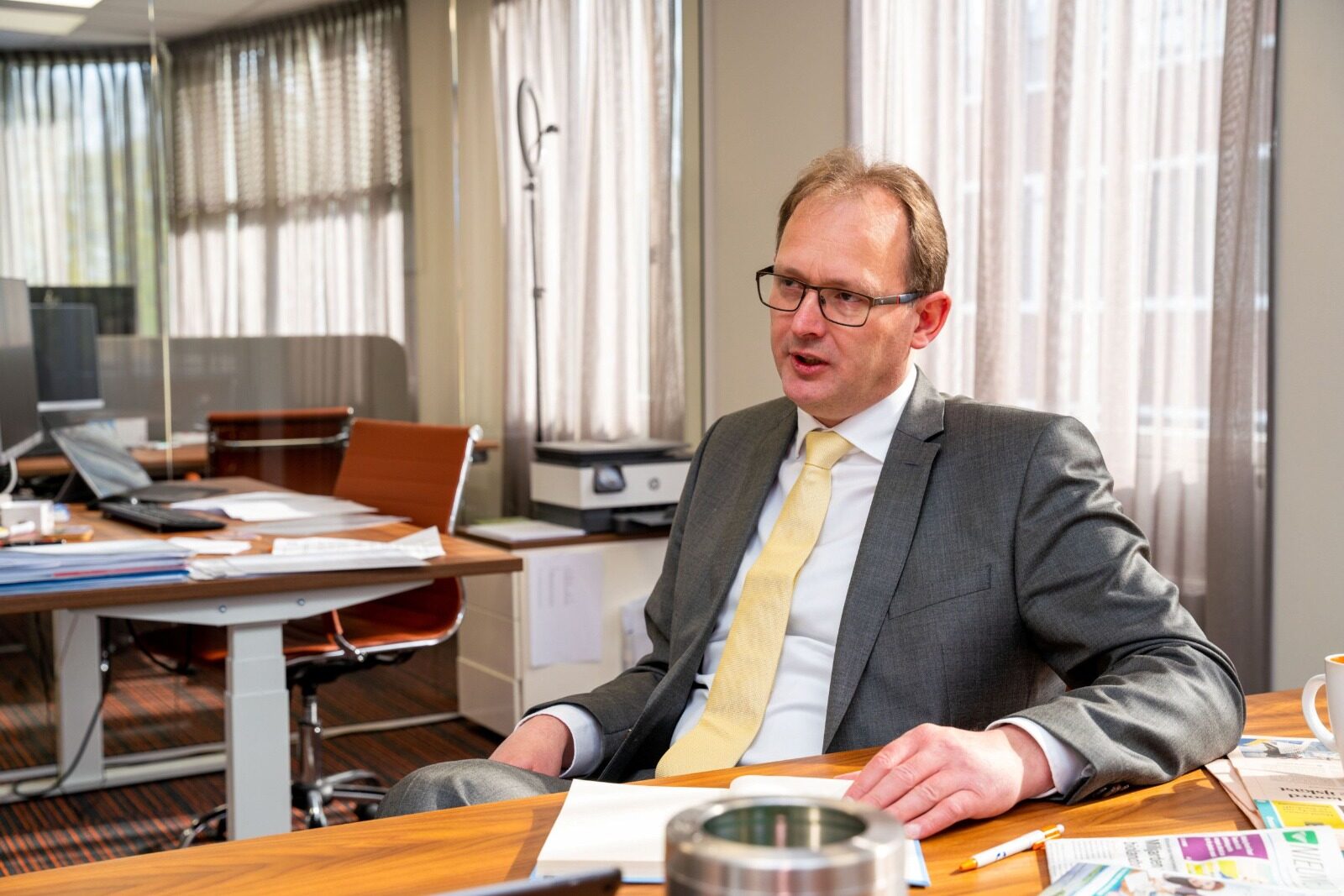
Christians and other religious minorities across South Asia continue to face violence, discrimination and intimidation, raising serious questions about whether the international community is doing enough to protect fundamental religious freedom. With the European Union wielding significant economic leverage through trade preferences and partnerships, should Brussels be prepared to use that leverage, and make respect for freedom of religion much more explicit. Interview with Mr. Bert-Jan Ruissen, MEP, member of the European Conservatives and Reformists Group.

Q: You hosted the European Parliament’s discussion on targeted violence against Christians in South Asia. When we talk about the persecution of Christians in South Asia, are we talking about isolated incidents, or do you see a broader regional pattern against the religious minorities in the region?
A: The event, “Targeted Violence against Christians in South Asia,” was hosted by MEP Matej Tonin (EPP) and by me, and organised by ADF International. The panel brought together first-hand witnesses and experts to brief policymakers on the urgent need for stronger EU engagement on freedom of religion or belief. This event was very important because across South Asia, Christians endure violence, intimidation, and deepening marginalisation simply for living out their faith. According to ADF International’s account, speakers called for stronger EU engagement on freedom of religion or belief and highlighted what we described as escalating violence against Christians in India and Pakistan. The organisation said that the discussion was intended to brief European policymakers about the situation and encourage greater EU attention.
Q: Are Christians becoming increasingly marginalized not only through physical violence, but also through laws, social pressure and restrictions on religious practice?
A: First of all, you must understand that South Asia is not one uniform environment, and Christians are not the only religious minorities facing persecution or discrimination. The main problems reported by human-rights and religious-freedom monitors are a combination of religious nationalism/majoritarianism, discriminatory laws, extremist violence, weak protection by authorities, and social/economic vulnerability. The main problems affecting Christians in the region are different: in some countries, accusations or rumours concerning Christianity can trigger attacks on individuals, churches, schools or Christian communities. In Pakistan, for example, Human Rights Watch reports that blasphemy accusations have provided a pretext for mob and vigilante violence, while authorities have sometimes failed to protect those accused. Human-rights organisations report cases in Pakistan in which Christian women and girls, in particular, have allegedly been abducted, forcibly converted and married. USCIRF continues to identify forced conversion as a problem affecting religious minorities, including Christians. The situation in India is rather different from Pakistan.
Q: India is called the biggest democracy in the world. The central problem in India is not lack of constitutional protection of the religious minorities, but growing pressure on the practical exercise of religious freedom.
A: You are right. India has constitutional protections for freedom of religion, but a number of states have adopted anti-conversion laws. Critics argue that these laws can be used against Christians and other minorities, particularly evangelical groups.
USCIRF reports arrests of Christians under state anti-conversion laws and says that such laws can restrict legitimate religious activity. At the same time, according to the United Christians Forum, between January and October 2025 alone, more than 600 incidents of violence were documented, averaging two attacks per day, including mob assaults, public humiliation, church disruption, and the demolition of homes.
Twelve Indian states now enforce anti-conversion laws, often used to intimidate and criminalise peaceful religious activity. This year, 123 criminal complaints, so called First Information Reports, have been filed against Christians, and several believers remain in prison across the country.
In some parts of India, Christian communities have experienced harassment, attacks on churches and accusations that Christian organisations are trying to convert Hindus.
USCIRF reports a broader deterioration in religious-freedom conditions for minorities and identifies harassment and violence affecting Christians alongside other religious minorities.
It is therefore more accurate to say that Christian minorities can be caught up in a wider conflict over religious identity and nationalism, rather than portraying every incident as a simple Christian-versus-Hindu conflict.
Q: Pakistan is a current GSP+ beneficiary. The European Commission adopted a new GSP regulation. What European institutions can do to force Pakistan to make further steps to protect Christians and other religious minorities before signing the new GSP+ agreement?
A: Let me tell you what are the biggest problems in Pakistan. Pakistan uses some of the world’s harshest blasphemy laws, including provisions carrying a mandatory death penalty. In 2024 alone, 344 new blasphemy cases were registered, many triggered by false or coerced allegations on social media and disproportionately targeting Christians.
False accusations continue to spark mob violence. Speakers referenced the 2023 Jaranwala attacks, where more than two dozen churches were burned, and the 2024 lynching of 74-year-old Christian Lazar (Nazir) Masih in Sargodha.
There’s an urgent need to introduce procedural changes in the blasphemy laws to curb false allegations that have often resulted in violent attacks on Christian settlements and individuals belonging to both the minority and majority communities. Moreover, a lack of effective prosecution gives the perpetrators of violence a sense of impunity, therefore the law enforcement agencies and the judiciary should ensure that any person or group involved in such incidents are brought to justice.
In an urgency resolution the European Parliament urged EU policymakers to remain vigilant: “unless the international community acts, countless innocent people will continue to suffer under laws that are used to silence and destroy the most vulnerable.”
The Pakistani Christian couple Shagufta and Shafqat had languished on death row for seven years on false blasphemy charges. The Lahore High Court overturned their death sentence in early June 2021. With the support of ADF International they made it safely to Europe after the parents of four faced death threats once the news of their acquittal broke.
Coming back to your question. Yes, GSP+ is one of the EU’s strongest economic instruments for encouraging Pakistan to improve protection of religious minorities, although it should be used carefully and tied to measurable human-rights benchmarks rather than simply threatening withdrawal.
Pakistan is a particularly relevant case because it is the largest beneficiary of the EU’s GSP+ scheme. Under GSP+, Pakistan receives preferential access to the EU market, while it is required to ratify and effectively implement 27 international conventions covering human rights, labour rights, environmental protection and good governance. The European Commission says compliance is monitored by the Commission and EEAS, with scrutiny also from Member States, Parliament and civil society.
Q: The Human Rights Subcommittee of the European Parliament has the right to raise questions to the European Commission on the minority problem, but does the EU have enough leverage over governments in the region? Should freedom of religion become a more explicit condition in EU trade, investment and partnership agreements?
A: In Pakistan, the answer is broadly yes. The EU is Pakistan’s second-largest trading partner, accounting for 14.1% of Pakistan’s total trade in 2025. This means the EU already possesses a mechanism that goes beyond diplomatic statements.
The particularly important point is that freedom of religion does not have to be invented as a new GSP+ condition. Pakistan’s existing GSP+ obligations already include international human-rights treaties relevant to religious freedom, equality, non-discrimination, freedom of thought, conscience and religion, and protection from arbitrary violence. The European Parliament itself has stated that Pakistan’s GSP+ status can be reviewed in connection with human rights and religious freedom.
And this is not merely theoretical. In March 2026, the European Commission stated that Pakistan remains subject to continuous GSP+ monitoring and that a monitoring report based on a late-2025 mission would inform the decision on Pakistan’s future GSP+ status.
Q: Is there any other Committee in the European Parliament dealing with this topic?
A: The Subcommittee on Human Rights can raise the human-rights concerns and question the Commission/EEAS. The Committee on International Trade has an important role concerning trade and GSP+. The Parliament as a whole can adopt resolutions and scrutinise the Commission’s implementation.
The Pakistan example demonstrates that these mechanisms can interact. During the 2025 EU–Pakistan inter-parliamentary meeting, MEPs discussed GSP+, human rights and rule of law together, rather than treating trade and human rights as entirely separate issues.
Q: Thank you for the interview